Garden Finance
Can financial literacy grow like a garden?
What if people could first experience financial concepts intuitively, and learn the terminology afterwards?
The idea
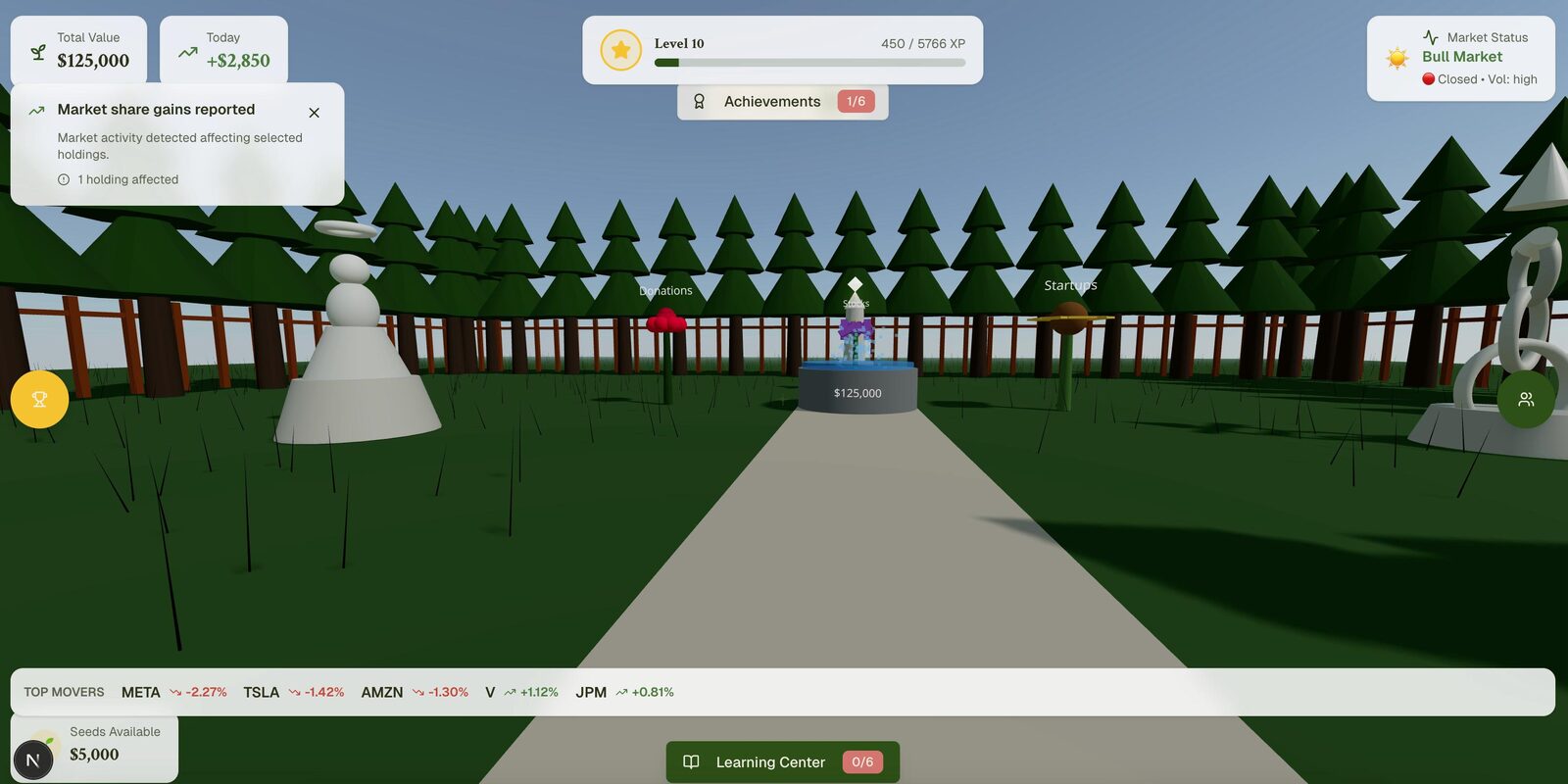
A stock rises. In a traditional financial app, a number turns green.
In Garden Finance, a flower grows.
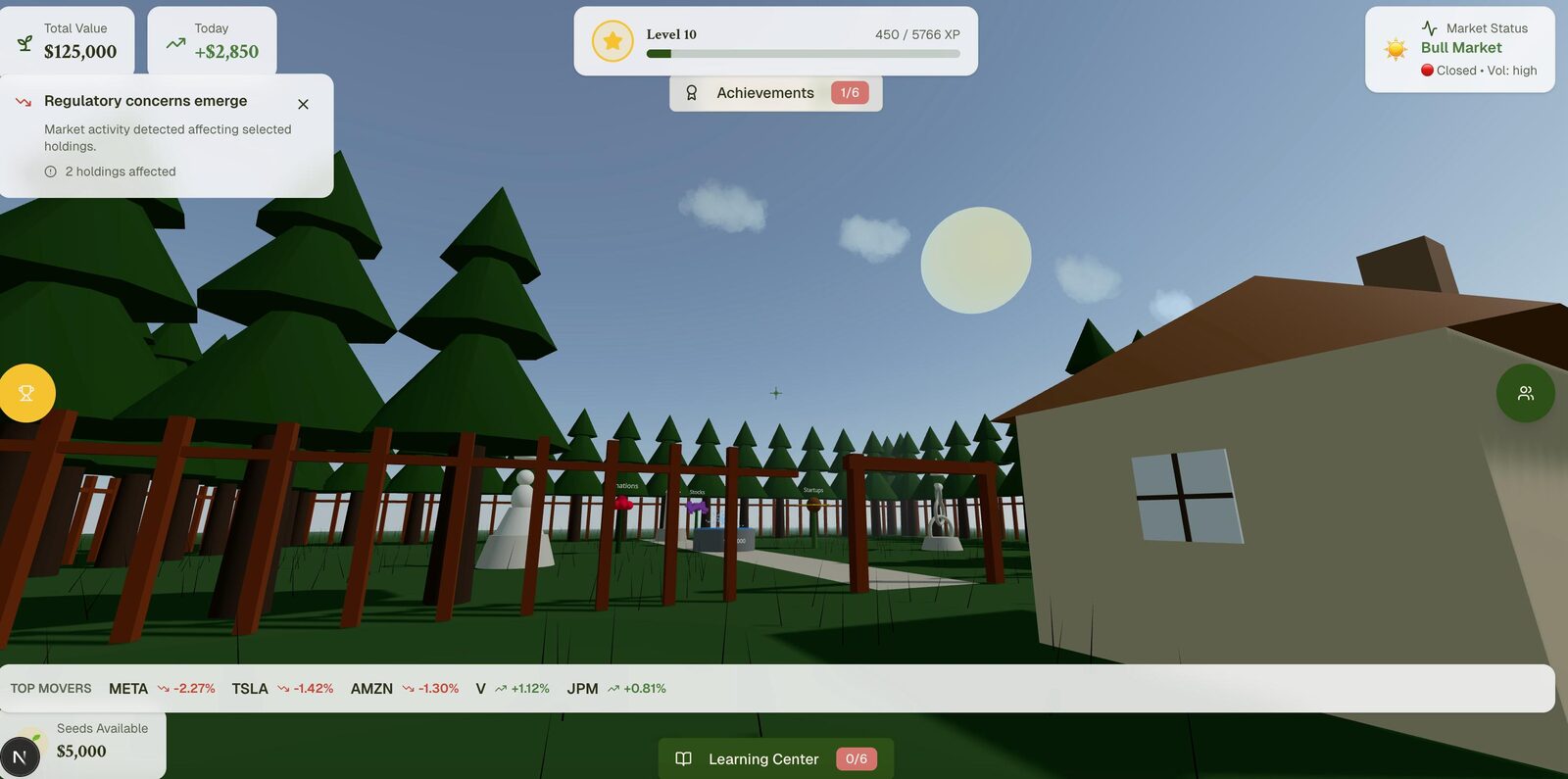
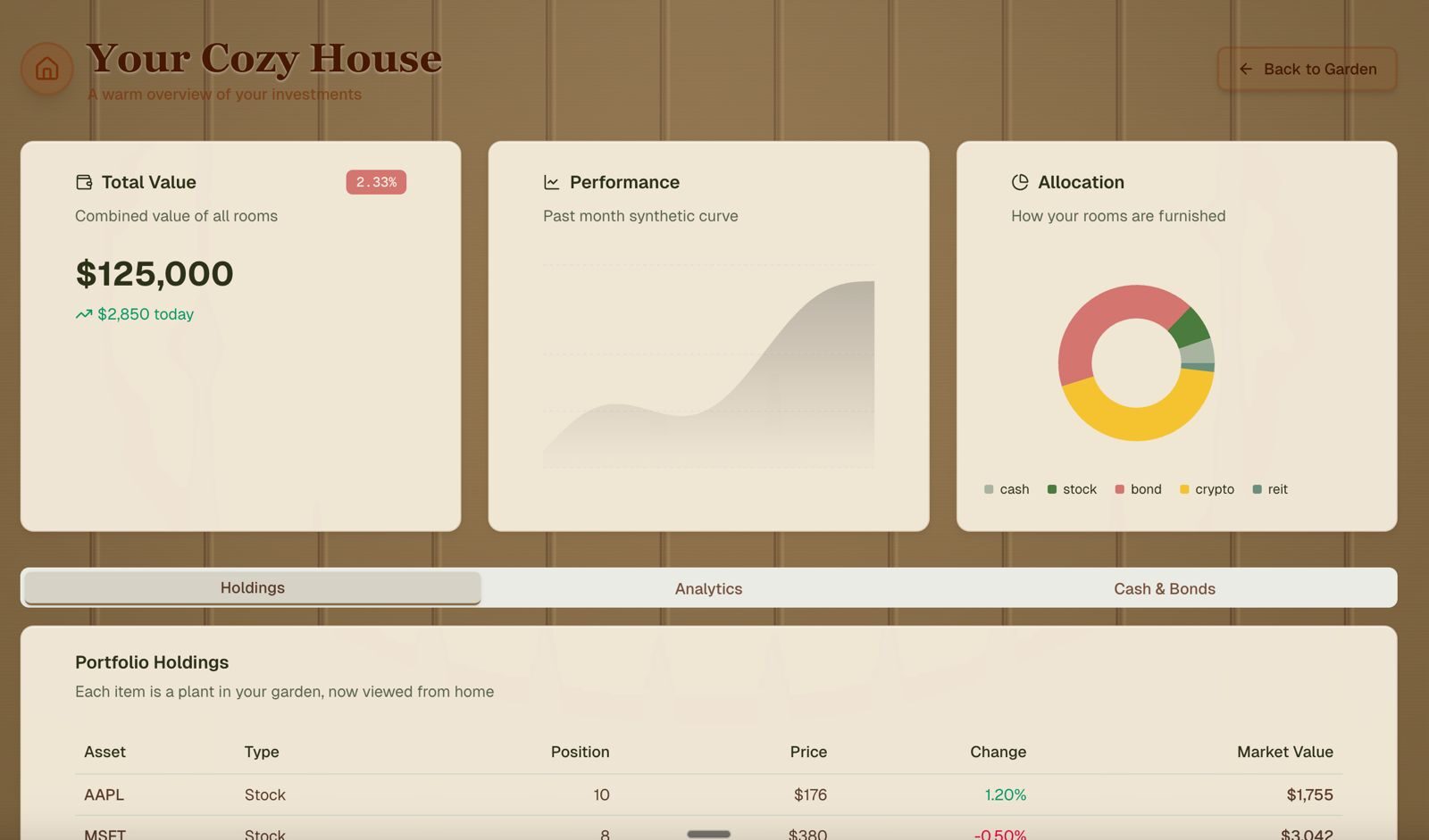
A volatile investment might lose and regain leaves quickly; a more stable one remains calm. Cash appears as seeds waiting to be planted. Diversification can be represented as a healthier, more varied ecosystem. The user can then enter their “Cozy House” to see the same ideas expressed through familiar financial concepts such as allocation, performance and holdings.
This is the central idea: experience first, terminology afterwards.
| Concept | In the garden | In the Cozy House |
|---|---|---|
| Volatility | A plant that loses and regains leaves quickly, beside one that stays calm | Performance |
| Cash | Seeds waiting to be planted | Cash & Bonds |
| Diversification | A healthier, more varied ecosystem | Allocation |
| Concentration risk | A garden dominated by one type of plant | Allocation |
Why it matters
Financial inclusion is no longer only about access. The World Bank’s Global Findex shows that access to formal financial services has expanded substantially, including among women. But having access to an account or investment platform does not necessarily mean having the knowledge or confidence to use it effectively. The World Bank therefore treats financial capability as a combination of knowledge, skills, attitudes and behaviours, not simply access to financial products.
Financial education matters. A large meta-analysis in the Journal of Financial Economics, covering 76 randomised experiments and more than 160,000 participants, found that financial education improves both financial knowledge and downstream financial behaviour. But effects vary considerably depending on how education is delivered, to whom, and at what moment (Kaiser et al., 2022).
The hypothesis
Instead of beginning with terms such as volatility, diversification or asset allocation, the product turns them into observable behaviour. A user might first notice that one plant moves dramatically while another grows steadily. Garden Finance can then explain that what they are seeing is volatility. A garden dominated by one type of plant can make concentration risk visible before presenting the portfolio percentages behind it.
The purpose is not to make finance “cute.” It is to reduce the distance between an abstract concept and an intuitive understanding of it.
The approach is supported indirectly by research showing that context and engagement matter. World Bank research has found that embedding financial education into entertainment can improve financial knowledge and influence some financial behaviours. That does not prove that a 3D garden will work, but it supports the broader principle that financial education can become more effective when people encounter it through something they already want to engage with.
Economic empowerment
Garden Finance should not be framed around the assumption that women are inherently less interested in finance. The more important issue is that women continue to face gaps in financial knowledge, confidence, access and participation.
The OECD has documented persistent gender differences in financial literacy and confidence, while the World Bank argues that financial education aimed at women should be designed around their actual needs, circumstances and experiences rather than delivered generically.
Garden Finance therefore asks whether a more intuitive and engaging interface could help reduce one of the barriers to participation: the feeling that finance is difficult, unfamiliar or not designed for you.
The impact pathway
Not “Garden Finance → reduced inequality.” More realistically:
- Better engagement
- Stronger financial understanding
- Greater financial capability and confidence
- More effective participation in financial services
- Greater economic agency and resilience
Research supports several parts of this chain, but Garden Finance still needs to prove its own contribution.
Sustainable development
If successful, Garden Finance could contribute to several UN Sustainable Development Goals.
SDG5
Gender Equality
The most direct fit: efforts to expand women’s economic participation and access to financial services.
SDG8
Decent Work and Economic Growth
Financial inclusion and access to finance support entrepreneurship and wider economic participation.
SDG10
Reduced Inequalities
Through the broader goal of economic inclusion.
These connections should not be treated as automatic impact claims. Garden Finance would need to demonstrate measurable improvements in financial understanding, confidence and behaviour.
Research agenda
The important experiment is not whether users prefer flowers to spreadsheets. It is whether someone who learns volatility, diversification or risk through Garden Finance understands the concept better, remembers it longer and can apply it in a new financial situation.
That can be tested against conventional financial education by measuring:
- Engagement
- Comprehension
- Delayed retention
- Confidence
- Transfer of knowledge
If Garden Finance can show meaningful improvements on those measures, its value becomes much more significant than gamification. It would suggest that one barrier to financial literacy is not only the complexity of finance itself, but the way we ask people to enter it.
People should not have to become interested in finance before finance becomes relevant to them.Sometimes understanding can begin somewhere more familiar, and grow from there.
Links
References
- World Bank, Global Findex Database. worldbank.org
- OECD, Joining Forces for Gender Equality. oecd.org
- Kaiser et al. (2022), Financial education affects financial knowledge and downstream behaviors, Journal of Financial Economics. sciencedirect.com
- World Bank, Making Financial Education Entertaining. worldbank.org
- World Bank Digital Financial Services, gender topic. digitalfinance.worldbank.org
- United Nations Sustainable Development Goals: SDG 5, SDG 8, SDG 10